
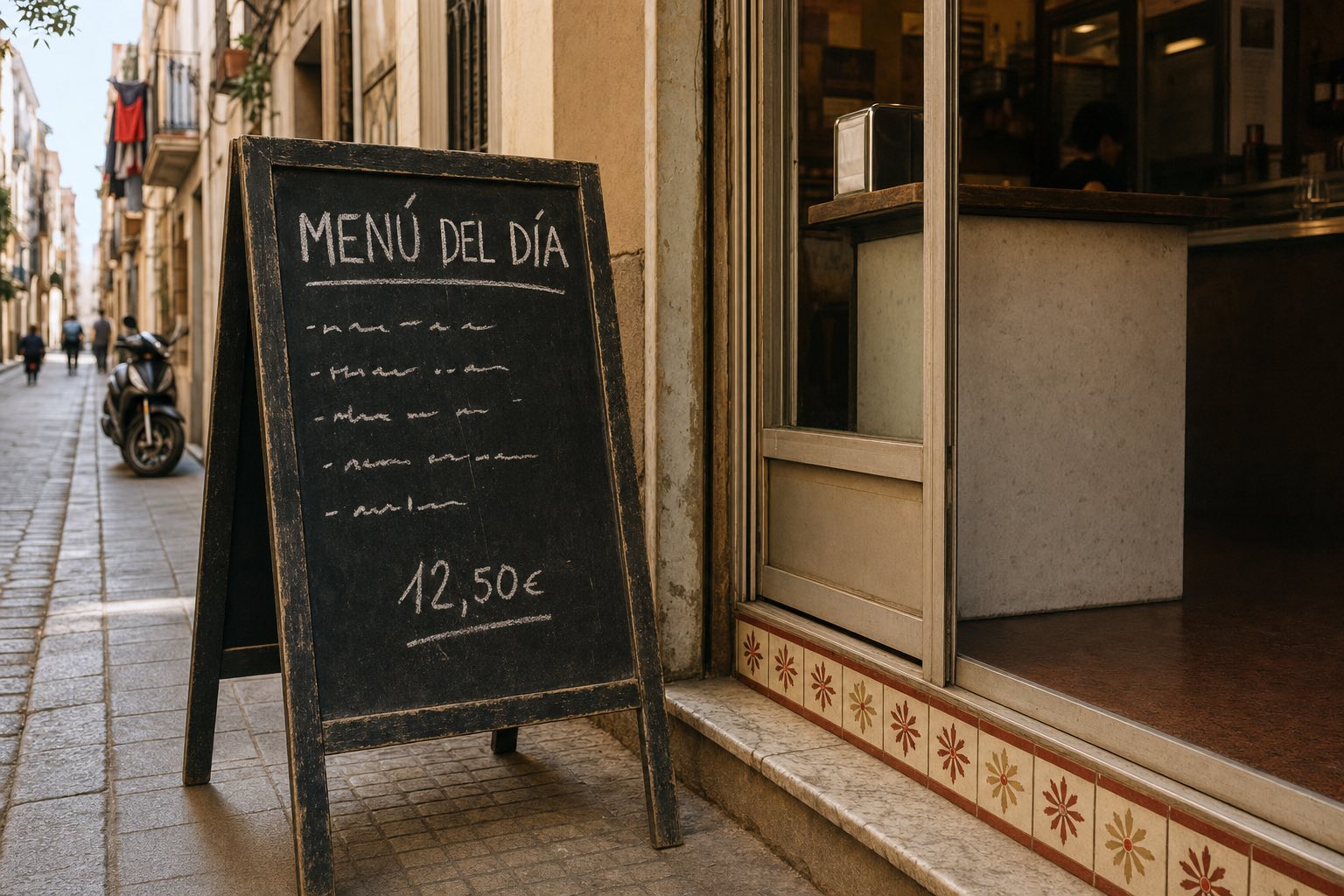
It's 1:20 pm, you have forty minutes, and the question is always the same: is there a menú del día near me? Not "the best in the city". Not "most recommended of 2024". The ones seven minutes' walk away that are still serving at 3:30 pm.
It's a very specific search and almost nobody answers it well. Google hands you blog listicles, TripAdvisor sorts by overall rating without telling you whether there's a menu today, and Maps shows you the bar on the corner without the one thing you need: what's on today and what it costs.
What "near me" means at lunchtime
Forget 5 km radiuses. At lunchtime, "near" is 400 to 700 metres — five to nine minutes on foot. Beyond that, the walk eats the lunch break.
That shrinks the problem to something manageable: in a dense urban area, that radius holds between 15 and 60 restaurants, and maybe only 5 or 10 have a menú del día today. The job isn't searching thousands, it's knowing which ten.
Today's menús del día
So it's clear what we're talking about, these are menus published today, with their dishes and prices:
Today's menús del día
Menú de hoy — actualizado cada día desde Appetece
Look at the format: a starter to choose, a main to choose, drink included, all for under €15. That's a menú del día. If they give you one dish and a drink and charge €16, that's a lunch deal — fine, but a different thing.
Why bars with a menú del día don't show up on Google
Here's the root of the problem, and it's worth understanding.
The menú del día lives on a blackboard by the door. It gets written at 11:00 am and wiped at 4:00 pm. There's no website, no updated listing, and if there's an Instagram it's a story that expired yesterday. The restaurant that feeds you best on your street may be exactly the one with the worst digital presence — because it's been full for thirty years without needing one.
That leaves three options:
- Go down and read blackboards. It works, but it costs you fifteen or twenty minutes of your own lunch break.
- Ask a colleague. Reliable and limited: they'll send you to the same three places every time.
- Look where someone has already collected the data. That's what we do at Appetece: gather published menús del día and put them on a map, updated daily.
Right now we have 2,606 restaurants in the catalogue and around 170 menus published every day, concentrated mainly in Barcelona and its metropolitan area, with Madrid underway.
What you should be paying
Using the real prices of the menus published today, the spread looks like this:
| Price | |
|---|---|
| The cheapest | €10.90 |
| One in four, below | €14.50 |
| Typical price (median) | €16.90 |
| One in four, above | €27 |
The €16.90 median is the number that matters: it's what a normal menú del día costs, at a normal place, today. If someone asks €22 for an unremarkable lunch menu, you're overpaying. If you find a complete one under €13, you've found something good — and it's probably a neighborhood bar with no website.
Watch the top of that table: above €27 these usually stop being menús del día and become lunchtime tasting menus, a different category and a different experience. We have the price breakdown by region if you want to compare with your area.
How to find the one in your area, today
Filter by neighborhood, not by city. "Menú del día in Barcelona" is 2,382 restaurants and useless to you. Your neighborhood is thirty, and that's already a decision.
These are the areas with the highest menú del día density we cover:
- Eixample — the highest concentration in the city, by far
- Ciutat Vella — plenty of choice, watch out for tourist traps
- Gràcia — neighborhood restaurants and market cooking
- Sant Martí and Poblenou — office district, menus built for workers
- Sants — some of the best prices in Barcelona
- Sarrià-Sant Gervasi — pricier menus, more careful cooking
- Madrid — still being built out, but with the good stuff in Barrio de Salamanca and Malasaña
Check the hours before you walk. The menú del día runs Monday to Friday, from 1:00 pm to 3:30 or 4:00 pm. Saturdays offer far fewer, and Sundays almost none.
Leave at quarter past, not half past. Ten minutes earlier is the difference between choosing among six mains and choosing between the two that are left.
Signs you've found a good one
- It's full of local workers at 2:00 pm on a Tuesday. Best indicator there is.
- The blackboard changes daily. If Monday's menu matches Thursday's, there's no kitchen, there's a freezer.
- There are three or four starters and as many mains. Not one (barely cooking) and not twelve (no way they're all fresh).
- Bread and a drink are in the price. If they're extra, it isn't a menú del día.
- The blackboard is handwritten. Sounds trivial and it works: it means someone wrote it this morning.
And if you don't fancy the usual today
The menú del día has a reputation for lentils and breaded steak, and that reputation is out of date. In an average urban area you'll find Korean, Peruvian, chifa, Japanese, Moroccan and ramen at menu prices, because those are the cuisines that absorb the format best: lots of produce, fast execution, generous portions.
If that's your route, we have the map of Asian food beyond sushi and the one on neighborhood restaurants, which is where the real menú del día lives.
What makes a menú del día good isn't being the best in the city. It's being close, being today's, and not wrecking your budget. All three at once.
What's on near you today? Check it on Appetece — menus updated every day.